
Senior Product Manager
at the intersection of
healthcare, fintech,
procurement & agentic AI.
Sixteen years translating ambiguous problems into shipped products — eleven in healthcare, five in fintech, and now actively building at the agentic AI frontier.
Explore work in healthcare, fintech & AI→A bridge between
strategy & system.
Eleven years building healthcare products — hospitals, EHR / EMR systems, payer platforms, claims, and quality systems — at companies including Napier Healthcare and IBM Watson Health. Five years in fintech and identity, at Reliance Jio and now Experian. Today I work at the intersection of all three: agentic AI for regulated domains, fraud detection and identity verification, and the quiet plumbing of enterprise B2B platforms.
I bridge business strategy and technical architecture — translating ambiguous problems into shipped products that move metrics.
Core Product
Competencies.
Shipped products &
AI experiments.
TPSS Security —
Operations
& Finance Portal.
A production operations and finance portal for a manpower-security business, replacing a multi-spreadsheet workflow with a single auditable system. Built independently in my own time for a real services business — currently live in production, running monthly paysheet cycles, GST-compliant invoicing, and PF/ESI compliance workflows across 8 functional modules.
Two surfaces from one codebase — a public marketing site for prospective clients, and a private role-aware operations portal for the leadership, operations, and finance teams. The portal enforces a maker–checker workflow where approved paysheets, issued invoices, and recorded receipts become immutable server-side. Historical numbers cannot drift.
Three roles. A per-screen, per-action permission grid an administrator can toggle without developer involvement. Authoritative rules enforced in the database, not the UI. Scheduled serverless jobs handle overdue-invoice sweeps, contract checks, and monthly backups.
AgentOps —
AI Agent
Governance Platform.


A multi-agent governance platform managing AI agents from registration through retirement — built to answer the question: what sits above the agents? The platform enforces a 7-stage lifecycle state machine, maker-checker approval workflows, eval-gated promotion, cost tracking per agent, LangSmith APAC trace observability, and an append-only audit log with no update or delete endpoint.
Currently governs two production AI systems: the GMP Deviation Review single agent and the MediAssist multi-agent clinical workflow — a Router + 5 specialist architecture where Haiku handles scheduling and order mapping, and Sonnet handles clinical reasoning tasks (SOAP scribe, lab results, billing). Every live MediAssist call pushes a PHI-anonymised trace to LangSmith and a cost record to the governance backend.
GMP Deviation Review
AI Assistant.


An AI assistant for pharmaceutical QA teams that compresses GMP deviation review from 20–60 minutes per incident to under 10 seconds — while maintaining auditability. A structured Claude agent retrieves the relevant sections from internal SOPs via TF-IDF search, then forces a 7-field JSON response through tool-use, with retry-on-validation-failure and a safe fallback that escalates by default.
The eval framework scores 15 golden cases on Groundedness, Classification, Escalation, and Clarity — measured against an always-escalate baseline.
ProcureOps —
Procurement
Governance Platform.
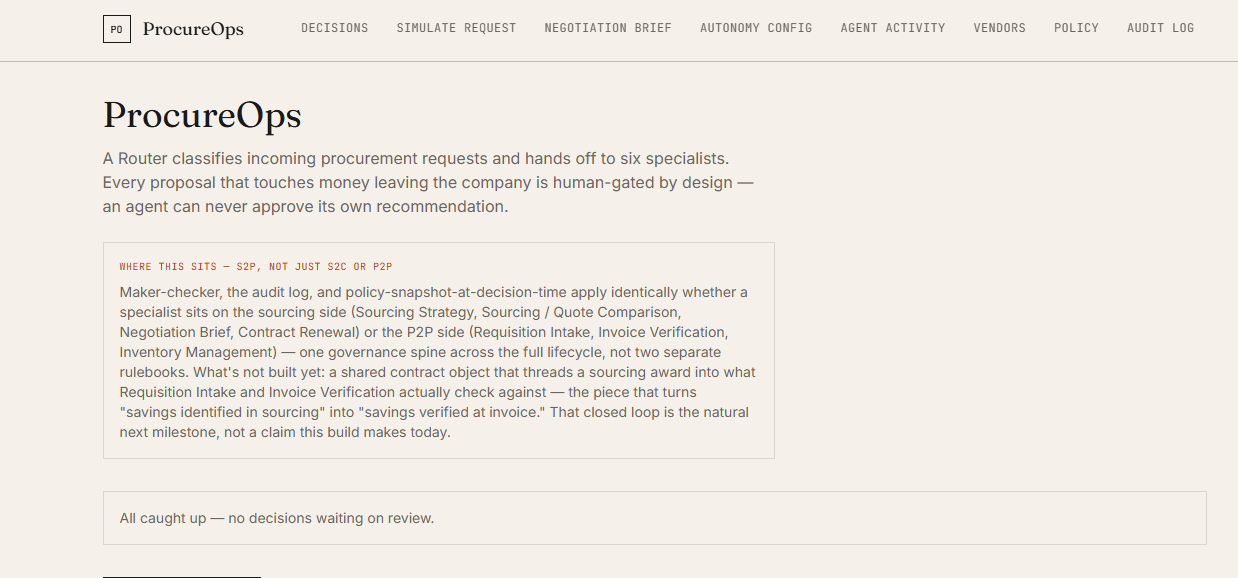
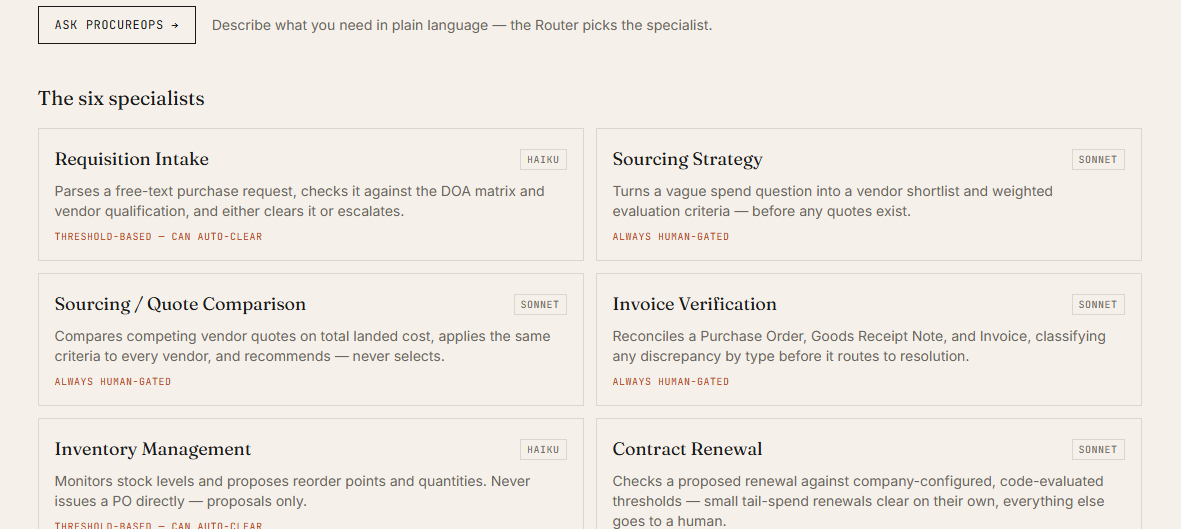
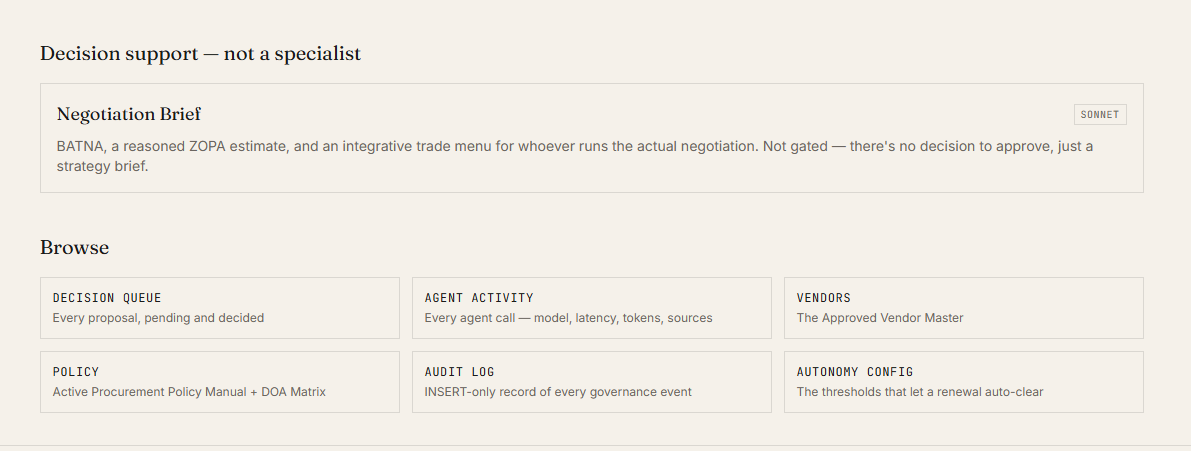
Third AgentOps governance vertical, alongside GMP Deviation Review and MediAssist — a Router classifies incoming procurement requests and hands off to six specialists spanning both sides of source-to-pay. Every proposal that touches money leaving the company is human-gated by design: an agent can never approve its own recommendation.
Positioned as an S2P governance platform, precisely: maker-checker, the audit log, and policy-snapshot-at-decision-time apply identically whether a specialist sits on the sourcing side (Sourcing Strategy, Sourcing / Quote Comparison, Negotiation Brief, Contract Renewal) or the P2P side (Requisition Intake, Invoice Verification, Inventory Management) — one governance spine, not two separate rulebooks. The closed-loop data half of S2P — a shared contract object threading a sourcing award into downstream requisition and invoice enforcement — is the deliberate next milestone, not a claim this build makes today.
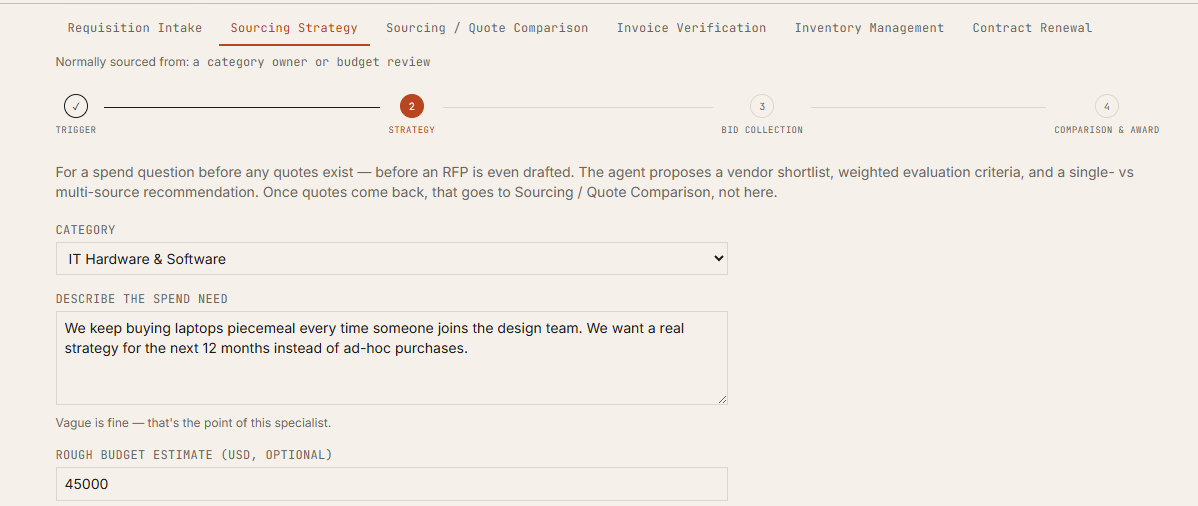
Bounded-autonomy Contract Renewal auto-clears only against thresholds a company explicitly configures per category, evaluated as plain code, never LLM judgment. Sourcing carries a winner's-curse check comparing a quote only against that same vendor's own price history. Negotiation Brief reasons in BATNA/ZOPA/trade-menu terms and Sourcing Strategy recommends a bidding mechanism (sealed-bid, English reverse, or Vickrey) grounded in the real qualified vendor pool — every computed statistic (win-probability, price deviation) comes from real historical data, handed to the LLM as ground truth, never fabricated by the model itself.
MedAssist AI


A Claude-powered clinical workflow application covering six phases of a patient encounter — from AI-assisted intake and appointment scheduling through to voice-transcribed SOAP notes, LOINC-mapped diagnostic orders, lab trend analysis, and auto-generated ICD-10/CPT claims. Built across two role-based portals for doctors and clinical assistants.
FraudShield
In active development


A mobile-first identity verification and fraud detection tool designed for India's Aadhaar-linked KYC market — banks, NBFCs, fintechs, and insurance teams. The current MVP scans for fraud signals including SIM swaps, synthetic identities, duplicate accounts, and velocity attacks, returning a 0–100 risk score in under two seconds. Designed around UIDAI masking patterns and Indian regulatory guidelines (RBI, DPDP Act).